My Journey Through School With Cerebral Palsy
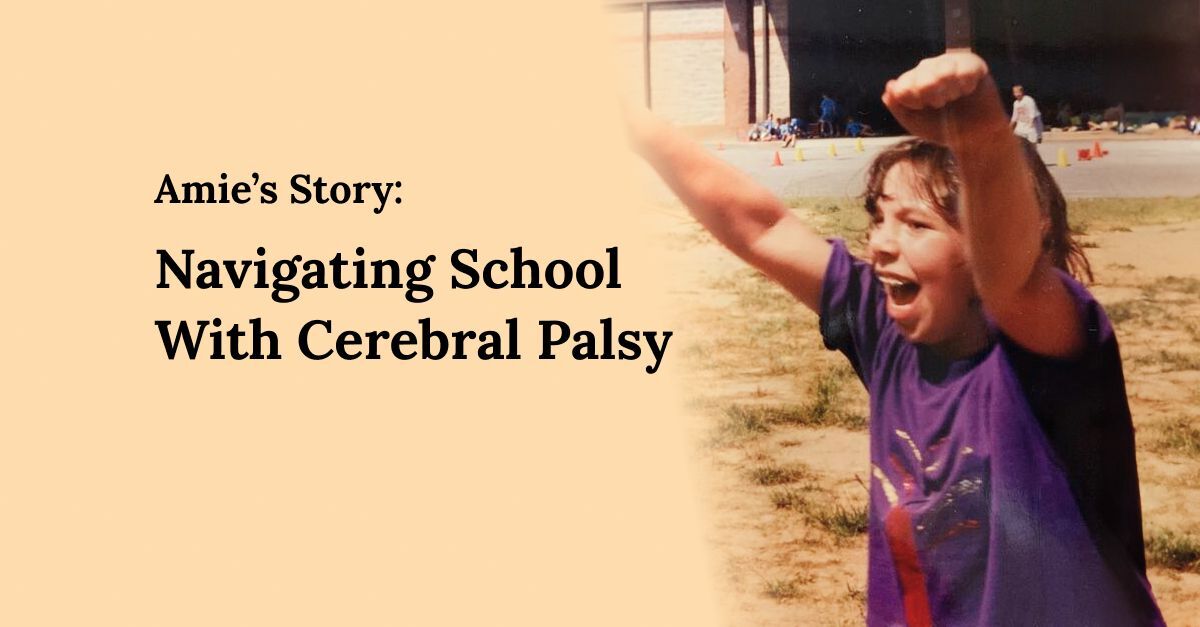
As the 2025–26 school year approaches, I want to share my educational journey. It's my hope that it can help other families facing the stress and uncertainty that sometimes come with having a child with special needs.
Navigating my education with cerebral palsy (CP) presented numerous challenges that were further complicated by the symptoms that often accompany the condition.
“At school, we worked a lot on fine-motor tasks. Amie’s tremors sometimes made things like writing more difficult. But she was never one to give up. She always had goals and wanted to get better, and she did!”
— Amie’s occupational therapist
My educational journey was anything but straightforward. I needed specialized support and adaptations to succeed, but confronting obstacles head-on helped me build resilience and a deep appreciation for personalized learning strategies.
2025 Back-to-School Tips for Children With CP
Looking back, I see how certain approaches, tools, and mindsets can make the school experience more positive for students with CP. This year’s back-to-school season is a good time to revisit some of those strategies.
Here are some back-to-school tips for kids with special needs:
- Organize IEP documents and set a clear timeline
Keep digital and paper copies of your child’s IEP (individualized education program). Mark review dates on your calendar so changes can be made before they’re urgent. - Establish a communication log with teachers and therapists
Use a shared notebook or document to track messages and meeting notes. This keeps everyone on the same page and avoids missed details. - Preview the school ahead of time
Visit the classroom before the first day to ease anxiety, get familiar with the space, and check that accessibility needs are met. - Share a one-page snapshot of your child’s strengths and needs
Give staff a short overview of your child’s learning style, accommodations, and key health or safety information. - Review and confirm that accommodations are in place
Make sure all IEP or 504 plan supports are ready and understood by the teachers, aides, and therapists who will use them. - Ease back-to-school jitters through routine sharing
Talk through the daily schedule in advance. Practice it at home so the first week feels more predictable and comfortable. - Maintain ongoing communication
Check in regularly with teachers and support staff. Address small concerns early to prevent bigger challenges later.
These steps can help make the start of the 2025 school year smoother for students with CP. With the right preparation and communication, families can reduce stress and focus on helping their child succeed.
My Experience With Public Schools and IEPs
As a student with cerebral palsy, I had the chance to attend both public and private schools, and each offered different opportunities and challenges that shaped my education and personal growth.
Public schools often have IEPs designed to address the unique learning needs of students with disabilities. They outline specific goals, accommodations, and services tailored to each student’s requirements.
IEP goals for students with cerebral palsy may include:
- Being given more time to take tests
- Getting to work in quieter settings
- Receiving verbal instructions for tests
- Other tailored accommodations
Classrooms often had two teachers to provide extra support, which was crucial for students who needed additional assistance.
Public schools may also offer students speech, physical, and occupational therapy. For someone with cerebral palsy like me, these resources were a must-have.
However, there were many moments when I longed to blend in and experience school as a “normal” student.
Related: Read Amie’s blog on cerebral palsy mental health challenges.
Transitioning to Private School
I started elementary school in a public setting, but my parents decided to transition me to a private school when it became clear that I wasn’t receiving the help I needed.
Starting a new school was never easy, as it involved adjusting to new environments and methods. However, the move was necessary to receive the support I needed to succeed. I loved my years at my first private school, even though I was a little more challenged than I was used to.
“She always had a smile on her face and was eager to learn. This was a private religious school, so the curriculum was rigorous. Amie had to work hard to do well.”
— Amie’s middle school teacher
One of the wonderful recognitions I received in 5th grade was the Eagle Award. This is awarded to one student who works hard but can never quite make the honor roll.
Receiving the Eagle Award meant the world to me, as it showed that my hard work was being recognized. I was honored to be the first recipient of this award, which continues to be given to students today.
Middle School and a New Learning Method
During my middle school years, my parents and I thought that it would be best if I transitioned into a new private school.
This school was different from my first private school because it was designed to help students with learning disabilities while allowing them to live up to their potential.
According to my middle school teacher, I benefited from 3 important factors:
- My mother was a great advocate for me with the teachers and the school.
- The school had the flexibility to make accommodations for special needs.
- I was always eager to learn and put in the effort needed to succeed.
For example, one factor in my success was a technique where teachers had us swipe our hands across a rough board while verbally affirming what we needed to remember.
This learning method, combined with the unwavering support from my teachers, boosted my reading level by two full grades.
Returning to Public High School Before Finding My Path
My second private middle school did not extend to high school, so I decided to try public school again.
Unfortunately, I didn’t receive the support I needed, which led me to transfer to a remarkable self-paced private school in the middle of my sophomore year.
This school offered a different experience from traditional high schools. It provided the flexibility and personalized attention I needed.
“She set high expectations for herself. She often made appointments to work outside of class to stay on top of her work. She also kept busy playing soccer!”
— Amie’s collaborative English teacher
One of the highlights was completing an internship as a physical therapy aid, which I could count as a school credit. This school’s small class sizes and focus on individual strengths greatly contributed to my learning.
While some may view my frequent school changes as excessive, navigating different educational environments can sometimes be necessary to find the right path to success.
I recall the headmaster at my high school graduation reading a quote along the lines of: It doesn't matter how long it takes you or what door you go through as long as you are successful. I couldn’t agree more.
Finding the Right Path: Success Through Persistence
My journey through different schools and educational environments may not have been straightforward, but it taught me that success is possible when you have the right support and determination.
For families facing similar challenges, it’s important to remember that every child’s path will be unique. The key is to advocate for your child, be open to exploring different educational settings, and remain persistent in seeking the resources they need.
Back to school for a child with disabilities can be stressful, but your child can thrive with patience and a willingness to adapt. Every challenge overcome is a step closer to success, and your support as a family makes all the difference.
If your child has been diagnosed with CP and you’re interested in exploring support options, call Cerebral Palsy Guide at (855) 220-1101 now to see how our team may be able to help.
 Written by:Amie Kroessig
Amie Kroessig is a Patient Advocate and Outreach Coordinator for Cerebral Palsy Guide. In her role, she provides resources and support to families and caregivers of children with cerebral palsy to help give them the quality of life they deserve.